Urban Form: Virgin and Child in Majesty
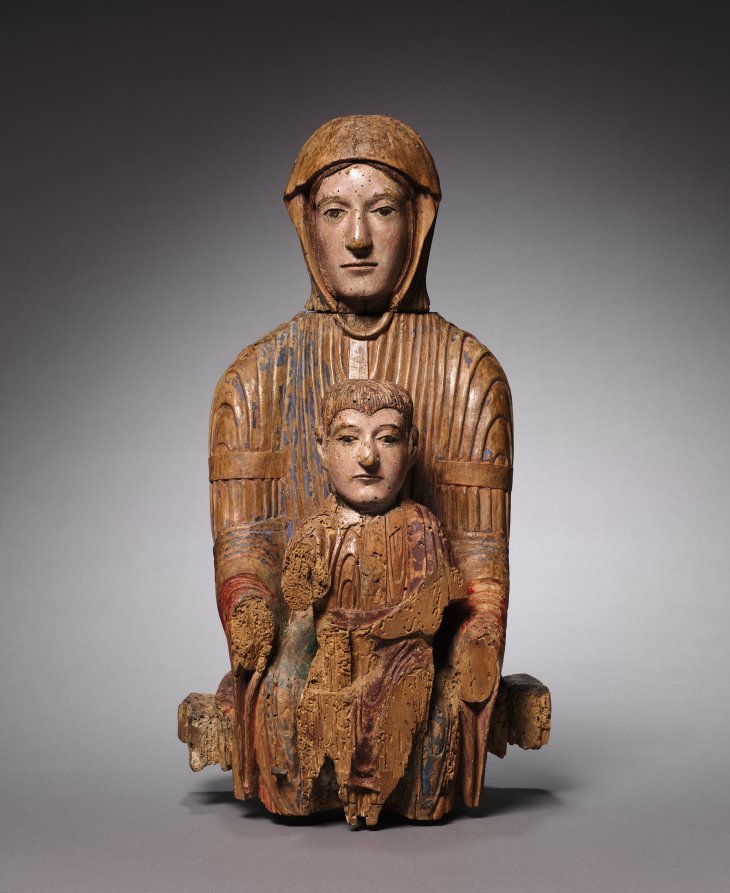
Structural Poetics: The Architectural Silhouette as Ideological Surface
The Virgin and Child in Majesty presents a paradox of volumetric containment and symbolic projection. The Madonna’s throne is not merely a seat but a structural cage—a gilded, geometric armature that simultaneously elevates and encloses the sacred body. For the 2026 executive silhouette, this translates into an oversized, architectural outer shell that functions as a mobile throne: a garment that asserts authority through sheer spatial occupation, yet remains rigorously controlled by linear seams and sharp, cantilevered shoulders. The ivory palette is not a passive neutrality; it is the color of unmarked power, the blank parchment upon which structural poetics are inscribed.
The artwork’s hierarchical composition—the Virgin’s vertical axis, the Child’s horizontal counterpoint, the throne’s diagonal buttresses—demands a garment that resolves these tensions into a single, coherent volume. The 2026 executive silhouette must reject soft draping in favor of precise, load-bearing geometry. Think of a double-breasted coat with a high, structured collar that rises like a Gothic arch, its lapels cut with the exactitude of a stone vault. The sleeves are not attached; they are cantilevered from the shoulder seam, creating a negative space that echoes the throne’s open framework. This is not a coat to be worn; it is a space to be inhabited.
Urban Materiality: From Gilded Wood to Engineered Fabric
The original artwork’s gilded surface and tempera-on-panel technique suggest a materiality that is both precious and rigid. For urban application, this translates into engineered textiles that mimic the structural integrity of wood and gold leaf. We propose a double-faced wool bonded to a micro-ceramic film, creating a fabric that holds its shape like a panel yet breathes like a weave. The surface is treated with a matte metallic finish—not reflective, but absorptive, capturing ambient city light without glare. This is the urban equivalent of gilding: a surface that announces its value through texture rather than shine.
The throne’s intricate tracery—the carved finials, the painted halos—becomes laser-cut perforations along the garment’s hem and cuffs. These are not decorative; they are functional apertures for ventilation and movement, their patterns derived from the artwork’s geometric underpinning. The perforations form a repeating mandorla motif—the almond-shaped halo that frames the Virgin—scaled down to a micro-architectural grid. When the wearer moves, the perforations create a kinetic shadow play, a silent language of authority that shifts with every gesture.
The Silhouette as Ideological Armature
The Virgin and Child in Majesty is fundamentally a work about containment: the divine contained within the human, the human contained within the throne, the throne contained within the frame. The 2026 executive silhouette must mirror this layered containment. The primary garment—a floor-length, A-line coat—is the outermost frame. Beneath it, a second skin of ivory silk crepe is cut with architectural precision: a high-necked, sleeveless tunic that references the Virgin’s undergarment, its seams tracing the body like a structural diagram. The coat is left open at the front, revealing this inner layer, creating a vertical axis of revelation that echoes the artwork’s central composition.
The coat’s shoulders are exaggerated, squared, and slightly raised, forming a horizontal lintel that visually supports the entire silhouette. This is not a power shoulder in the 1980s sense; it is a structural bracket, a load-bearing element that distributes the garment’s volume. The sleeves are cut in a single, continuous piece with the body—a kimono-inspired dolman—to avoid any seam that might disrupt the silhouette’s monolithic presence. The result is a garment that reads as a single, sculpted volume, its only interruption the precise line of the lapel and the rhythmic pattern of the perforations.
Surface as Narrative: The Politics of the Unadorned
The artwork’s gold ground is not mere decoration; it is a field of absolute value, a surface that denies depth and insists on the primacy of the image. In the 2026 executive silhouette, the ivory fabric serves a similar function. It is a blank field that refuses narrative, forcing the viewer to confront the garment’s structure rather than its ornament. This is a political choice: in an era of visual saturation, the unadorned surface becomes a statement of sovereign restraint. The only embellishment is the laser-cut mandorla pattern, which is not applied but subtracted from the fabric—a negative-space ornament that speaks to the artwork’s original technique of carving into the gesso.
The garment’s interior is lined with a deep slate silk, visible only at the cuffs and hem when the wearer moves. This hidden color is a deliberate counterpoint to the ivory exterior, a secret that mirrors the artwork’s reverse side—the unpainted wood that supports the gilded surface. It is a reminder that every structure has a foundation, every surface a substrate. For the executive, this interior color is a private signature, a mark of authenticity that only the wearer and their closest associates will ever see.
Conclusion: The Silhouette as Sovereign Space
The Virgin and Child in Majesty offers a definitive model for the 2026 executive silhouette: a garment that is not worn but inhabited, a mobile architecture that asserts presence through volume, precision, and material integrity. The oversized, ivory coat with its cantilevered shoulders and laser-cut mandorla pattern is not a fashion statement; it is a structural manifesto. It reclaims the body as a site of power, not through adornment, but through the poetics of containment. In the urban landscape, this silhouette becomes a moving monument—a throne without a king, a frame without a painting, a surface that refuses to be read but demands to be seen.