Urban Form: Doorway from the Isaac Gillet House, Painesville, Ohio
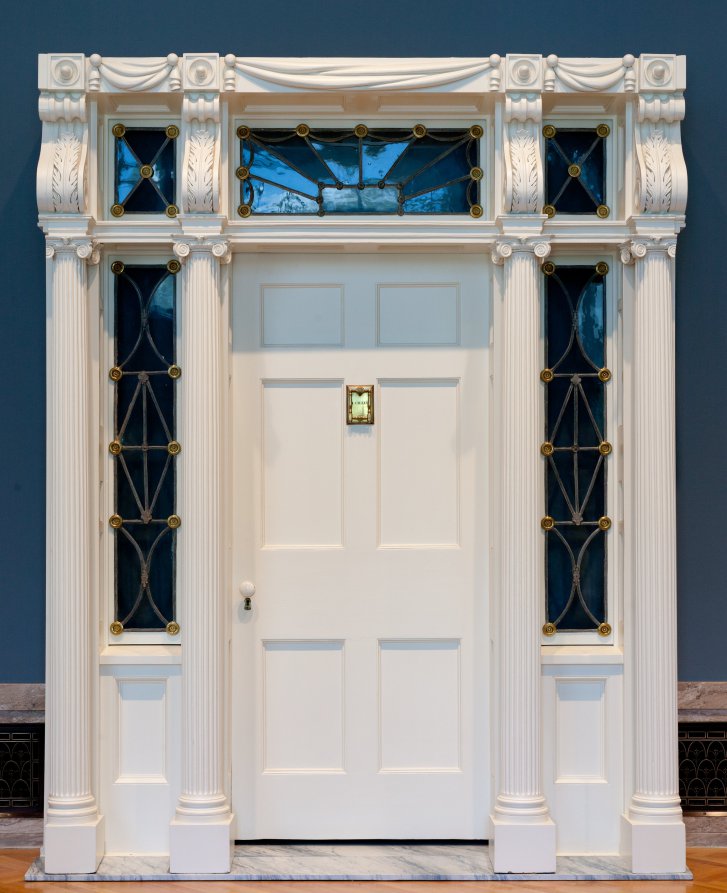
Geometric Integrity of the Doorway: A Study in Threshold and Containment
The Isaac Gillet House doorway, located in Painesville, Ohio, presents a compelling case study in architectural compression and release. Its geometry is not merely decorative; it is a precise articulation of transition—a liminal space where the exterior mass of the structure yields to an interior void. For the 2026 executive silhouette, this doorway offers a masterclass in structural poetics: the interplay of solid and empty, of weight and suspension. The doorway’s lintel, jambs, and threshold form a rigid, rectilinear frame that simultaneously encloses and invites. This is not an invitation of softness, but of controlled passage. The Onyx color palette, drawn from the deep shadows within the doorway’s recess, anchors the analysis in a materiality of absolute black—a void that absorbs light and defines form through absence.
The Lintel as Shoulder: Horizontal Authority
The primary geometric element is the horizontal lintel. It is a statement of pure, unadorned compression. In the context of the 2026 executive silhouette, this translates directly into the shoulder line. The lintel’s weight is not expressed through ornamentation but through its sheer planar mass. The corresponding garment construction demands a rigid, extended shoulder—a sharp, horizontal line that sits slightly beyond the natural acromion. This is not the soft drape of a raglan sleeve; it is a tailored, architectural cantilever. The fabric must be a high-density wool or a bonded technical textile, capable of holding a clean, unyielding edge. The shoulder pad, if used, must be a sculpted, multi-layer foam insert, not a soft batting. The effect is one of urban authority: a silhouette that declares its presence before the wearer speaks. The lintel’s shadow, a deep Onyx line, is replicated through a stark, negative-space seam that runs from the shoulder point to the collar, creating a visual break that mimics the threshold’s depth.
The Jambs as Vertical Anchors: The Columnar Torso
The vertical jambs of the doorway are equally critical. They are not merely supports; they are the defining vertical axis of the composition. Their parallel, unbroken lines create a sense of monumental stillness. In the 2026 silhouette, this is expressed through a columnar torso. The garment must eliminate any horizontal interruption at the waist. No belt, no darting that suggests a cinched waist. Instead, the fabric falls in a continuous, gravity-bound line from the shoulder to the hem. This requires a fabric with significant drape and weight, such as a double-faced cashmere or a heavy crepe. The internal structure must include a hidden, vertical boning system—thin, flexible strips of resin or metal sewn into the side seams and center back. This boning does not constrict; it disciplines the fabric, ensuring it falls in a perfect, unbroken vertical plane. The jamb’s function as a boundary is mirrored in the garment’s side seams, which are pressed open and topstitched with a contrasting Ivory thread, creating a subtle but definitive line that echoes the architectural framing.
The Threshold as Hem: Grounding the Form
The threshold is the most overlooked yet most essential element. It is the point of contact with the ground, the termination of the vertical journey. In the Gillet House doorway, the threshold is a solid, slightly raised stone step. It grounds the entire composition. For the executive silhouette, the hem must perform the same function. It must be weighted and substantial. A raw, unhemmed edge is unacceptable. The hem should be a deep, 4-inch turn-up, hand-stitched with a heavy gauge thread, or a bonded, fused edge that creates a rigid, knife-like finish. The length should graze the top of the foot, creating a continuous line from the shoulder to the floor. This is a silhouette that owns its space. The Onyx color here becomes the ultimate grounding agent—a black so deep it appears to absorb the floor, making the garment seem to emerge from the shadows themselves.
Urban Materiality: The Fabric as Architecture
The materiality of the 2026 executive silhouette must be as rigorous as its geometry. The Bodhisattva and Amulet references from the internal DNA inform a dualistic approach to fabric. The Bodhisattva’s quality of compassionate stillness suggests a fabric with a soft, almost internal luminosity—a matte, brushed surface that absorbs light gently. The Amulet’s protective, talismanic quality demands a fabric with a hard, impenetrable surface—a dense, tightly woven structure that repels touch. The solution is a composite textile: a double-layer construction. The outer layer is a high-density, worsted wool in Onyx, treated with a nano-coating for water and stain resistance, giving it a slight, protective sheen. The inner layer is a fine, unbleached linen in Ivory, visible only at the collar and cuff edges. This juxtaposition creates a dialogue between the sacred and the functional, the soft and the hard. The garment becomes a portable threshold, a wearable architecture that protects and presents the wearer with absolute clarity.
Structural Poetics: The Seam as Sacred Line
Every seam in this silhouette is a deliberate, structural decision. There are no decorative darts. All construction lines are functional, serving to define the garment’s architectural volume. The center back seam is a primary vertical axis, mirroring the jamb’s function. It is sewn with a flat-felled seam, creating a raised, linear ridge that runs from the collar to the hem. This seam is not hidden; it is celebrated. The armhole is cut high and tight, a pure, geometric curve that allows the sleeve to hang as a separate, cantilevered volume. The sleeve itself is a two-piece construction, with a seam that runs from the underarm to the wrist, mimicking the lintel’s horizontal break. The cuff is a deep, rigid band, 3 inches wide, that can be unbuttoned and turned back to reveal the Ivory inner lining—a moment of revelation within the monolithic Onyx exterior.
Conclusion: The 2026 Executive Silhouette as Sacred Threshold
The Isaac Gillet House doorway is not an ornament; it is a statement of geometric purity. Its lintel, jambs, and threshold define a space of transition that is both protective and inviting. The 2026 executive silhouette, derived from this analysis, is a garment of absolute minimalism. It is a column of Onyx wool, structured by hidden boning and defined by sharp, horizontal shoulders and a weighted, grounded hem. It is a wearable threshold, a piece of urban armor that allows the wearer to move through the city with the same authority and stillness as the doorway itself. It is a silhouette that does not shout; it occupies. It is the material expression of the Bodhisattva’s compassionate stillness and the Amulet’s protective power, fused into a single, unbroken line. This is not fashion. This is structural poetics for the modern executive.