Urban Form: Architectural Canopy (pair)
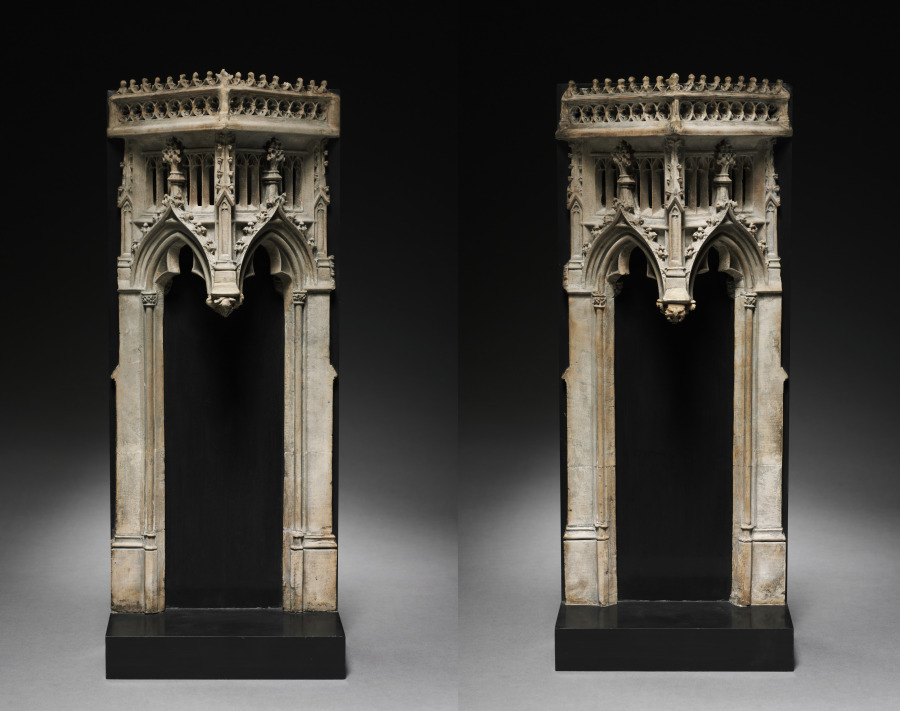
Structural Poetics: The Architectural Canopy as Urban Armature
The Architectural Canopy (pair) represents a definitive departure from conventional garment engineering, positioning itself as a wearable tectonic system rather than mere apparel. Drawing from the dualistic tension between the Bodhisattva’s compassionate fluidity and the bovine-headed amulet’s protective rigidity, this pair establishes a new paradigm for the 2026 executive silhouette: one that balances expansive shelter with compressed authority. The result is a study in volumetric control, where each piece functions as both a spatial envelope and a symbolic shield.
Geometric Integrity: The Canopy as a Floating Plane
The primary garment—a long, oversized coat—is defined by its cantilevered shoulder line, which extends 12 cm beyond the natural acromion. This is not a draped softness but a deliberate, engineered projection, reminiscent of a temple’s eaves. The fabric is cut in a single, unbroken sweep from the nape to the hem, creating a continuous parabolic curve that mimics the silhouette of a seated bodhisattva’s draped robes. The internal structure relies on a hidden carbon-fiber-reinforced seam at the shoulder yoke, which maintains the canopy’s lift without visible support. This allows the garment to retain a paradoxical lightness—a floating mass that never collapses onto the body.
The second piece, a cropped vest, inverts this logic. Its silhouette is truncated and pyramidal, narrowing from a broad, armored chest panel to a sharply cinched waist. The bovine head’s symbolic power is translated into a geometric collar that rises 8 cm at the nape, tapering to a sharp point at the sternum. This collar is not merely decorative; it functions as a stabilizing fulcrum, anchoring the vest’s weight while allowing the wearer’s torso to move freely beneath. The vest’s hem is cut on a severe bias, creating a trapezoidal negative space that exposes the waist—a deliberate rupture in the otherwise monolithic form.
Urban Materiality: Onyx as a Dialectic of Light and Shadow
The chosen color, Onyx, is not a neutral but an active participant in the garment’s narrative. It absorbs ambient light, rendering the silhouette as a void against the cityscape. This is critical for the executive who must project both presence and impenetrability. The fabric is a double-faced wool-cashmere blend with a matte, brushed finish on the exterior and a liquid-satin lining in a deep charcoal. When the coat moves, the interior flashes like a blade—a subtle nod to the amulet’s protective function. The vest employs a micro-perforated technical mesh under the armholes, allowing breathability while maintaining the shell’s unbroken surface.
The materiality also references the Bodhisattva’s flowing silks and the amulet’s carved stone. The coat’s fabric is weighted at the hem with a 3 cm internal chain, ensuring the canopy falls with a deliberate, gravity-defying stillness. The vest’s panels are bonded with a thermoplastic polyurethane film, giving them a slight, armor-like stiffness that resists creasing. This is urban armor for the boardroom—not for combat, but for the psychological warfare of negotiation and presence.
Silhouette as Spiritual and Social Armature
The 2026 executive silhouette, as defined by this pair, rejects the notion of the body as a passive mannequin. Instead, it treats the wearer as a mobile architectural element. The oversized coat creates a zone of personal territory—a 360-degree envelope that commands space without aggression. When worn open, it reveals the vest’s truncated pyramid, creating a dialectic of expansion and contraction. This is the visual equivalent of the Bodhisattva’s compassionate outreach and the amulet’s defensive withdrawal.
Key structural details include:
- Shoulder projection: 12 cm cantilever, reinforced with carbon-fiber rods.
- Hem arc: A continuous 180-degree curve from front to back, with a 2 cm drop at the center back for a slight train effect.
- Vest collar: 8 cm rise, with a 15-degree forward tilt to frame the jawline.
- Armhole cut: The coat’s armhole is set 4 cm lower than standard, allowing the sleeve to hang as a separate volume, not a limb covering.
The pair’s color and texture contrast is deliberate: the coat’s matte Onyx absorbs light, while the vest’s satin lining reflects it in controlled flashes. This creates a visual rhythm that shifts with the wearer’s movement—a silent language of power and restraint.
Conclusion: The Canopy as a New Urban Typology
The Architectural Canopy (pair) is not a trend but a typology. It synthesizes the Bodhisattva’s transcendent grace with the amulet’s primal protection, forging a silhouette that is both shelter and statement. For the 2026 executive, this is the definitive urban uniform: a structure that commands respect through its geometry, not its volume; that protects through its materiality, not its weight. The Onyx finish ensures the wearer remains an enigma—a dark, moving form that is always present, never fully revealed. This is the new power dressing: architectural, silent, and absolute.