Minimalist
Slate
Urban Form: Fragment of a Band with Abstract Pattern
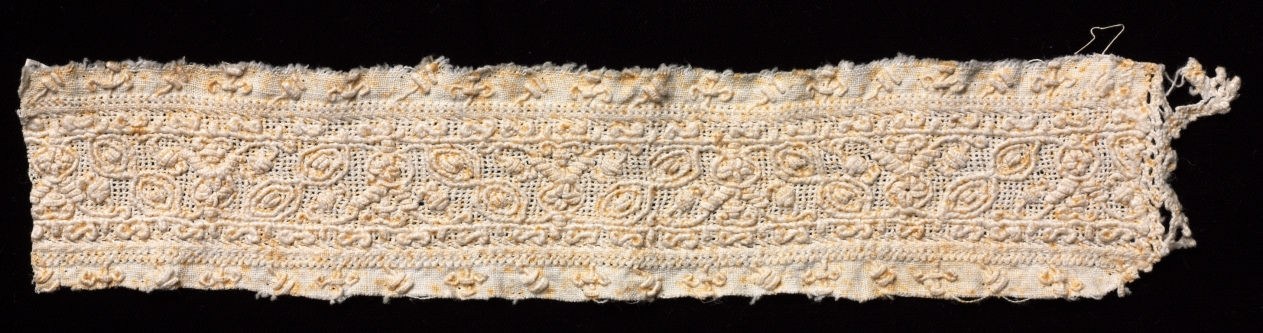
Technical Deconstruction: The Fragment as a Formal Proposition
The subject under analysis—a fragment of a band bearing an abstract pattern—is not a garment. It is a provocation. In the context of Addison Fashion’s Urban Silhouette Research for 2026, this fragment functions as a pure formal unit, stripped of narrative weight. Its value lies not in what it depicts, but in what it *is*: a discrete, material event. This aligns precisely with the aesthetic paradox articulated in the source text: the tension between representational depth (the narrative of David’s *Death of Socrates*) and existential depth (the mute, material presence of the ceramic cup). For the NYC executive wardrobe, this tension is resolved by privileging the latter. The fragment’s abstract pattern is not a story; it is a structural device.1. Form: The Geometry of the Fragment
The fragment is defined by its incompleteness. It is a band—a horizontal strip—suggesting a garment’s hem, a sleeve cuff, or a structural seam. Its abstract pattern is not decorative; it is a formal constraint. The pattern’s rhythm—whether geometric, biomorphic, or calligraphic—creates a visual cadence that disrupts the garment’s silhouette. In the 2026 executive wardrobe, this disruption is intentional. It breaks the monotony of the minimalist uniform, introducing a point of non-narrative tension. Key Formal Properties: - **Horizontal Banding:** The band’s orientation imposes a horizontal axis on the vertical plane of the body. This creates a visual counterpoint to the elongated, vertical lines of a tailored coat or a fluid dress. The band acts as a visual stop, a moment of compression within the silhouette’s flow. - **Abstract Pattern as Structure:** The pattern is not a print; it is a texture, a weave, or a bonded layer. It must be *felt* as much as seen. The pattern’s abstraction—its refusal to signify—forces the viewer to engage with the material itself. This is the “existential depth” of the ceramic cup: the pattern is not a symbol; it is a surface. - **Fragment as Unfinished Gesture:** The band is a fragment, not a whole. This incompleteness is a design strategy. It suggests a garment that is perpetually in process, a silhouette that refuses closure. For the executive, this signals a rejection of static perfection in favor of dynamic, lived-in form.2. Color: Slate as a Field of Neutrality
The selection of Slate—a deep, cool gray with undertones of blue and charcoal—is not arbitrary. Slate is the color of urban infrastructure: concrete, steel, and shadow. It is the color of the city’s non-narrative background. In the context of the fragment, Slate functions as a neutral field that absorbs the abstract pattern without competing with it. Color as a Formal Agent: - **Absorption vs. Reflection:** Slate absorbs light, reducing glare and flattening the surface. This is critical for the abstract pattern. A high-contrast color would amplify the pattern’s narrative potential; Slate suppresses it, returning the pattern to pure form. - **Tonal Range:** Slate exists in a narrow tonal band—from #708090 to #2F4F4F. This limited range creates a monochromatic field that unifies the fragment with the garment’s body. The pattern becomes a subtle variation within the same tonal family, not a separate element. - **Urban Camouflage:** In the NYC context, Slate is the color of anonymity. It allows the executive to move through the city without visual noise. The fragment’s abstract pattern, rendered in a slightly lighter or darker Slate, becomes a private detail—a secret rhythm visible only at close range.3. Silhouette Integration: The Fragment in the 2026 Wardrobe
The fragment must be integrated into a silhouette that respects its formal properties. For the 2026 NYC executive, three silhouette archetypes are relevant: Tailored: A structured blazer with a Slate wool body. The fragment appears as a horizontal band at the hem, just above the hip. The abstract pattern is a jacquard weave in a slightly lighter Slate. This creates a visual break in the blazer’s vertical line, a moment of compression before the garment’s fall. Fluid: A Slate silk crepe dress with a columnar silhouette. The fragment is a bonded panel at the waist, creating a subtle cinch. The abstract pattern is a matte finish against the crepe’s sheen. This introduces a textural shift without altering the garment’s flow. Oversized: A Slate cashmere coat with a dropped shoulder. The fragment appears as a wide band at the cuff, interrupting the sleeve’s volume. The abstract pattern is a ribbed knit structure, adding weight and density to the coat’s otherwise soft drape.4. The Paradox of Depth: Narrative vs. Material
The source text poses a critical question: does a mute object—a fragment, a cup—possess a “deeper” aesthetic than a narrative one? For the 2026 executive wardrobe, the answer is a strategic yes. The executive operates in a world saturated with narrative: quarterly reports, performance reviews, brand stories. The garment must offer respite from this narrative overload. The fragment’s abstract pattern, rendered in Slate, provides a non-verbal, material experience. It is a form of visual silence. This is not a rejection of meaning, but a redefinition of it. The fragment’s depth is not in what it represents, but in how it occupies space. It is a three-dimensional reality—a band of fabric, a pattern of threads, a field of color. This is the “existential depth” of the ceramic cup: a depth that requires no decoding, only presence.5. Conclusion: The Fragment as a Minimalist Imperative
For Addison Fashion, the fragment of a band with an abstract pattern in Slate is not a decorative detail. It is a formal argument. It argues that the 2026 executive wardrobe must prioritize material over narrative, structure over symbol, and presence over representation. The fragment’s horizontal banding, its abstract pattern, and its Slate field all converge to create a garment that is *felt* before it is *read*. This is the urban silhouette of the future: a silhouette that acknowledges the city’s noise but refuses to amplify it. The fragment is a quiet disruption, a moment of compression within the flow of the day. It is the executive’s silent partner—a formal device that says nothing, but occupies space with authority. In the end, the fragment’s depth is not in its story, but in its stillness. And in a city that never sleeps, stillness is the ultimate luxury.
Technical Insight
NYC Perspective: Translating Slate tones into Minimalist silhouettes.