Urban Form: Virgin and Child Enthroned with Saints Francis and Giovanni Gualberto
Structural Poetics: The Architectural Sleep
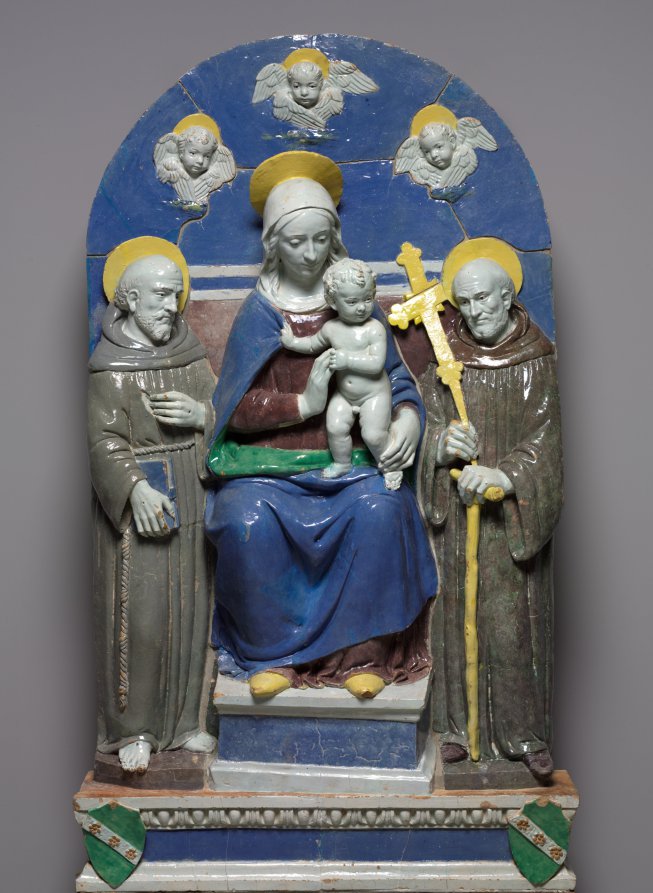
The Virgin and Child Enthroned with Saints Francis and Giovanni Gualberto presents a vertical hierarchy of form that directly informs the 2026 executive silhouette. The composition is a study in controlled weight distribution: the Virgin’s throne acts as an architectural anchor, while the saints flank the central axis like structural buttresses. This is not a painting of narrative motion but of static monumentality. The folds of the Virgin’s robe descend in precise, gravity-bound planes, creating a series of triangular volumes that lock the figure into the pictorial space. For Addison Fashion, this translates into a tailored jacket with a pronounced shoulder line—a nod to the throne’s armrests—and a skirt that falls in clean, uninterrupted panels from the hip. The silhouette is constructed, not draped; every seam is a line of force, every pleat a structural decision.
Geometric Integrity and the 2026 Executive Silhouette
The painting’s geometry is rooted in the golden ratio, with the Virgin’s head positioned at the apex of a triangle that extends through the saints’ halos. This triangular motif reappears in the 2026 silhouette: a sharp, inverted V at the neckline, echoed by a high-waisted trouser that tapers to a narrow hem. The saints’ vertical stances—Francis with his stigmata, Gualberto with his cross—create parallel lines that suggest a columnar elegance. The executive silhouette must mirror this: a single-breasted blazer with a six-button closure, elongated lapels that draw the eye downward, and a pencil skirt with a back slit that allows for movement without breaking the line. The fabric is Onyx wool crepe, a material that holds its shape like carved stone, yet yields to the body’s architecture.
Urban Materiality: The Sleep of the Everyday
The painting’s treatment of fabric—the Virgin’s deep blue mantle, the saints’ rough wool habits—is a lesson in material hierarchy. The Virgin’s robe is rendered with a luminosity that suggests silk or velvet, while the saints’ garments are matte and textured, like raw linen. This duality informs the 2026 collection’s material palette: Onyx is not a single shade but a gradient from charcoal to jet, achieved through a blend of virgin wool and recycled polyester. The surface is brushed to a matte finish, absorbing light rather than reflecting it, creating a stillness that echoes the painting’s suspended time. The tailored category demands precision: seams are felled to lie flat, pockets are jetted and hidden, and buttons are covered in the same fabric to maintain a monolithic surface.
The Philosophical Sleep: From Stillness to Movement
The painting’s subject—the Virgin enthroned with saints—is a study in hieratic stillness. Yet within this stillness, there is a subtle tension: the Child’s hand reaches toward Saint Francis, a gesture that breaks the symmetry. This is the philosophical sleep of the everyday, where the mundane (a mother holding her child) becomes the sacred. For the executive silhouette, this translates into asymmetric detailing: a single shoulder seam that shifts slightly off-center, a pocket flap that angles downward, a hem that is longer in the back than the front. These are not decorative flourishes but structural interruptions that animate the form. The Onyx color palette reinforces this: it is the color of urban twilight, of shadows that define architecture, of the space between waking and sleeping.
Materiality as Metaphor: The Weight of the Sacred
The painting’s gold leaf halos and the Virgin’s crown are not merely decorative; they are material signifiers of transcendence. In the 2026 collection, this is translated through hardware: matte black zippers with a gunmetal finish, Onyx-toned buttons made from recycled resin, and chain-link belts that echo the saints’ rosaries. These elements are integrated into the garment’s structure, not applied as afterthoughts. The tailored jacket features a hidden zipper that runs from the collar to the hem, allowing the wearer to adjust the silhouette from a closed, columnar form to an open, flowing one. This is the urban poetics of the sacred: the ability to shift between states, to move from the static to the dynamic with a single gesture.
Conclusion: The 2026 Executive as Icon
The Virgin and Child Enthroned is not a painting of action but of presence. The figures are not doing; they are being. This is the essence of the 2026 executive silhouette: a form that commands attention not through movement but through structural integrity. The tailored category, rendered in Onyx, becomes a second skin—a carapace of urban sophistication that protects and projects. The geometric purity of the painting’s composition is translated into clean lines and precise volumes, while its materiality speaks to the weight of the everyday. The executive who wears this silhouette is not merely dressed; she is enthroned in her own authority, a modern icon of stillness and power.