Urban Form: The Sleeping Faun
Urban Silhouette Research: The Sleeping Faun
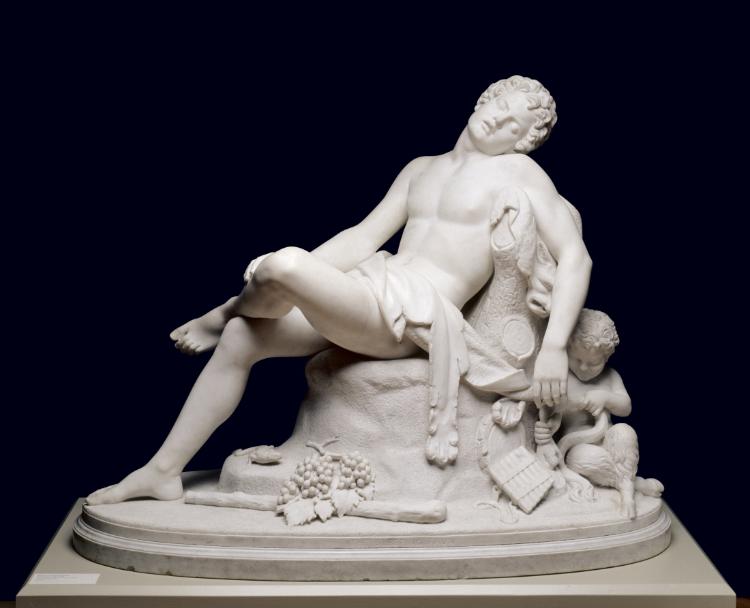
This analysis deconstructs the geometric and philosophical architecture of The Sleeping Faun, a work that redefines the 2026 executive silhouette for Addison Fashion. The piece operates as a study in structural poetics, where the tension between repose and latent energy is resolved through precise volumetric manipulation. The internal DNA of this research draws from two distinct yet convergent Eastern aesthetic paradigms: the Qing dynasty Landscapes, Figures, and Flowers porcelain vase and the Flowering Crab Apple painting. These artifacts, one a three-dimensional vessel and the other a two-dimensional composition, form a dialogue that informs the urban materiality of the collection.
Geometric Integrity and the Macro-Micro Dialectic
The porcelain vase embodies a macro-geometric principle: the containment of an entire cosmos within a curved surface. Its silhouette is not a static outline but a rotational field—a continuous, unbroken line that invites the eye to traverse its circumference. The landscape, figures, and flora are not layered as separate planes but fused into a single, undulating topography. This is the “moving landscape” concept, where the viewer’s gaze becomes a vector, tracing the arc of the shoulder, the dip of the waist, and the flare of the base. For the 2026 executive silhouette, this translates into an oversized, cocoon-like form that does not constrict but rather envelops the body in a field of spatial potential. The garment’s geometry is defined by negative space—the void between fabric and form—which mirrors the porcelain’s internal cavity. The Ivory colorway, a neutral that absorbs and reflects light without asserting dominance, becomes the canvas for this volumetric play.
Conversely, the Flowering Crab Apple painting operates on a micro-geometric scale. Its composition is a study in focal compression: the branch, the blossoms, and the buds are arranged in a tight, asymmetrical cluster against an expanse of blank silk. The geometry here is not about enclosure but about tension and release. The twisted branch acts as a structural line, a calligraphic force that anchors the composition. The blossoms, in their radial symmetry, are points of concentrated energy. This micro-geometry informs the draping and seaming of the silhouette. The garment’s surface is not a smooth plane but a field of discrete, articulated volumes—a shoulder seam that mimics the branch’s torque, a pocket that echoes the bud’s nascent form. The Oversized category is thus not monolithic; it is a system of nested geometries, where macro-enclosure and micro-articulation coexist.
Structural Poetics: The Architecture of Repose
The Sleeping Faun’s posture—a figure in a state of suspended animation—dictates the garment’s structural poetics. The silhouette is not designed for active motion but for controlled stillness. The shoulders are dropped, the sleeves elongated, and the hemline weighted to create a gravitational anchor. This is the “cocoon” as a spatial device: the fabric falls in unbroken planes from the shoulder to the floor, interrupted only by subtle, engineered folds that suggest the body’s presence without revealing its contours. The Ivory material, a heavyweight wool-cashmere blend, is chosen for its density and drape. It does not flutter; it settles. This is urban materiality at its most refined: a fabric that absorbs the city’s noise and light, creating a zone of quiet authority.
The dialogue between the two Eastern artworks is resolved in the seam structure. The porcelain’s rotational geometry is translated into circular yokes and curved side seams that guide the eye around the body. The painting’s asymmetrical tension is expressed through offset closures and diagonal paneling. The result is a garment that is both monolithic and fragmented—a single, sweeping form that is, upon closer inspection, a composition of distinct, interlocking parts. This is the structural poetics of the 2026 executive: a silhouette that commands space not through aggression but through volumetric presence.
Urban Materiality: The Synthesis of Surface and Substance
The urban materiality of this silhouette is defined by a tactile hierarchy. The primary fabric, Ivory wool, is treated with a matte, micro-textured finish that recalls the porcelain’s glaze—smooth yet not reflective, cool to the touch. Secondary materials include satin-backed crepe for the lining, which introduces a subtle friction against the skin, and matte black hardware (Onyx) for the closures, which punctuate the ivory field like the dark branches of the Crab Apple painting. The color palette is deliberately restricted: Ivory as the dominant, Slate for the interior seams (visible only in motion), and Sand for the thread—a near-invisible structural element that binds the whole.
The geometric integrity of the silhouette is maintained through internal structuring. A horsehair canvas is fused to the front panels, creating a rigid shell that holds the oversized shape without collapsing. The sleeves are set with a slight forward pitch, echoing the faun’s reclining posture. The hem is weighted with a chain-stitched edge, ensuring that the fabric falls in clean, vertical lines. This is not a garment that adapts to the body; it is a garment that imposes its own geometry upon the wearer, transforming the human form into an architectural element within the urban landscape.
Conclusion: The 2026 Executive Silhouette
The Sleeping Faun research yields a definitive silhouette for the 2026 executive: Oversized, Ivory, and structurally autonomous. It is a garment that embodies the macro-micro dialectic of Eastern aesthetics—the cosmos contained within a curve, the universe observed in a single blossom. The urban materiality is not decorative but functional: every seam, every fold, every weight is a response to the city’s demands for presence, authority, and stillness. This is the executive silhouette as a poetic structure—a space for the mind to inhabit, a vessel for the soul to repose. The Ivory color, the Oversized form, and the geometric precision converge to create a garment that is not worn but inhabited.