Fluid
Ivory
Urban Form: Krishna sporting with the gopis in the Jumna River, from a Bhagavata Purana
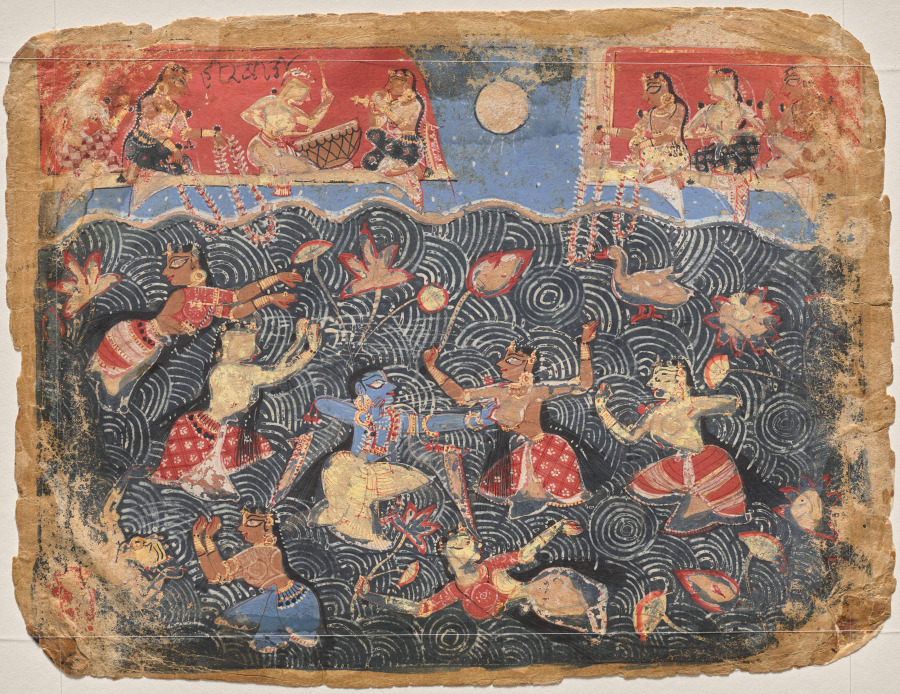
Deconstructing the Divine: The Jumna River as a Masterclass in Fluid Architecture
The Bhagavata Purana’s depiction of Krishna sporting with the gopis in the Jumna River is not a pastoral idyll; it is a treatise on the physics of draped volume, the semiotics of wet fabric, and the choreography of bodies in aqueous suspension. For the 2026 NYC executive, this 16th-century manuscript painting offers a radical departure from the rigid tailoring that dominates corporate power dressing. The work’s formal logic—rooted in the interplay of clinging textiles, undulating water lines, and the counterpoint of flesh against cloth—translates directly into a wardrobe strategy predicated on **controlled liquidity**.I. The Silhouette: From Static Frame to Kinetic Flow
The painting’s central formal innovation is the elimination of the vertical seam. Krishna and the gopis are rendered not as discrete figures but as a continuous, interlocking mass of curvilinear forms. Their garments, saturated with river water, adhere to the body in a manner that simultaneously reveals and obscures—a paradox that the contemporary designer must replicate through **bias-cut construction** and **weighted jersey**. In the 2026 executive context, this translates to a shift away from the structured shoulder and the nipped waist. Instead, the primary silhouette is the **column with a liquid interior**: a long, unbroken line from shoulder to hem, achieved via fabrics that possess both drape and memory. Think four-ply silk crepe or a technical viscose blend with a matte finish. The garment does not impose a shape; it negotiates one with the wearer’s movement. The Jumna’s waterlines—rendered as rhythmic, parallel arcs—become the blueprint for **strategic seam placement** that mimics the body’s flexion points, allowing the suit jacket to move as a second skin rather than a carapace. The gopis’ raised arms and tilted torsos introduce a diagonal energy that disrupts the horizontal stability of the river. This is the **asymmetric closure**—a single-button jacket that fastens off-center, or a trouser with a curved waistband that rises higher at the hip. The goal is not asymmetry for its own sake, but a deliberate unbalancing that suggests motion arrested mid-gesture. For the executive, this means a blazer that appears to have been thrown on, not engineered—yet its cut is meticulously calculated to maintain a clean line when in repose.II. Color as Atmosphere: The Ivory Spectrum and Its Subtexts
The palette of the Jumna scene is dominated by the ivory of the gopis’ drapery and the pale gold of Krishna’s form, set against the deep indigo of the water. This is not a neutral; it is a **chromatic argument** about luminosity and absorption. Ivory, in this context, is not a blank canvas but a reactive surface—it takes on the hue of its environment, reflecting the river’s blue and the sky’s warmth. For the 2026 NYC wardrobe, this dictates a move toward **monochromatic dressing in off-whites**, but with a critical caveat: the ivory must be *alive*. This is achieved through fabric choice. A double-faced wool in ivory reads as architectural; a silk organza in the same tone reads as ethereal. The executive’s strategy is to layer these textures within a single outfit—an ivory cashmere turtleneck under an ivory wool crepe coat, with a silk-ivory trouser that catches light differently at each step. The effect is a subtle, non-verbal communication of depth and complexity, mirroring the painting’s use of ivory to denote spiritual purity while remaining tethered to the physical. The Jumna’s indigo serves as a cautionary note: color is not an accent but a **structural element**. In the painting, the water is not a background; it is the force that shapes the figures. For the wardrobe, this suggests that a single, saturated piece—a deep indigo overcoat or a slate-toned skirt—should function as the *organizing principle* of the outfit, not an afterthought. The ivory garments are then positioned as responsive elements, their neutrality allowing the darker piece to define the spatial relationships.III. The Poetics of Wet Fabric: Translating Adhesion into Tailoring
The most radical formal aspect of the painting is its depiction of wet cloth. The fabric does not float; it *clings*, revealing the navel, the thigh, the curve of the hip. This is a direct challenge to the Western tailoring tradition’s obsession with concealment and structure. The 2026 executive interpretation is not literal transparency but **selective adhesion**—garments that use interior construction to create moments of tension and release. This is achieved through **strategic seaming and darting** that creates a “second skin” effect at specific points—the small of the back, the inner wrist, the nape of the neck—while allowing fullness elsewhere. A sheath dress with a fitted bodice that flares slightly at the hem; a trouser that is narrow through the hip but widens to a subtle bootcut. The effect is a garment that appears to have been shaped by the wearer’s own kinetic energy, much as the gopis’ saris are shaped by the river’s current. The painting’s use of **repetitive line**—the water’s ripples, the folds of cloth—finds its sartorial equivalent in **pin-tucking and micro-pleating**. These are not decorative; they are functional, allowing the fabric to expand and contract with movement while maintaining a consistent visual texture. For the executive, this means a blouse with vertical tucks that reads as a solid surface but moves with the fluidity of a liquid.IV. The Synthesis: A Wardrobe for the Fluid Executive
The Jumna River scene ultimately proposes a model of dress that is neither purely utilitarian nor purely expressive. It is **performative in its restraint**—every fold, every line, every tonal shift is deliberate, yet the overall effect is one of effortless spontaneity. The 2026 NYC executive, operating in a landscape of glass towers and digital surveillance, requires a wardrobe that communicates authority without rigidity, competence without aggression. The fluid silhouette, rendered in ivory with strategic injections of indigo or slate, achieves this. It is a form that acknowledges the body’s physicality while elevating it through material intelligence. The bias cut, the asymmetric closure, the selective adhesion—these are not trends but **technical responses** to the demands of a professional life that is increasingly fluid in its own right. The executive does not wear armor; they wear a negotiation between self and environment, much as Krishna and the gopis negotiate the river’s currents. In this reading, the Bhagavata Purana is not an ancient artifact but a **contemporary design brief**. Its formal vocabulary—liquid drape, reactive color, kinetic seam placement—offers a blueprint for a wardrobe that is at once timeless and urgently modern. The ivory column dress, the asymmetric wool coat, the indigo trouser that anchors the ensemble: these are the garments of a professional who understands that true power lies not in resistance but in **adaptive flow**. The Jumna’s waters do not fight the bodies that enter them; they shape and are shaped in return. So too must the 2026 executive’s wardrobe—a living system of form and color, perpetually in dialogue with the wearer and the world.
Technical Insight
NYC Perspective: Translating Ivory tones into Fluid silhouettes.