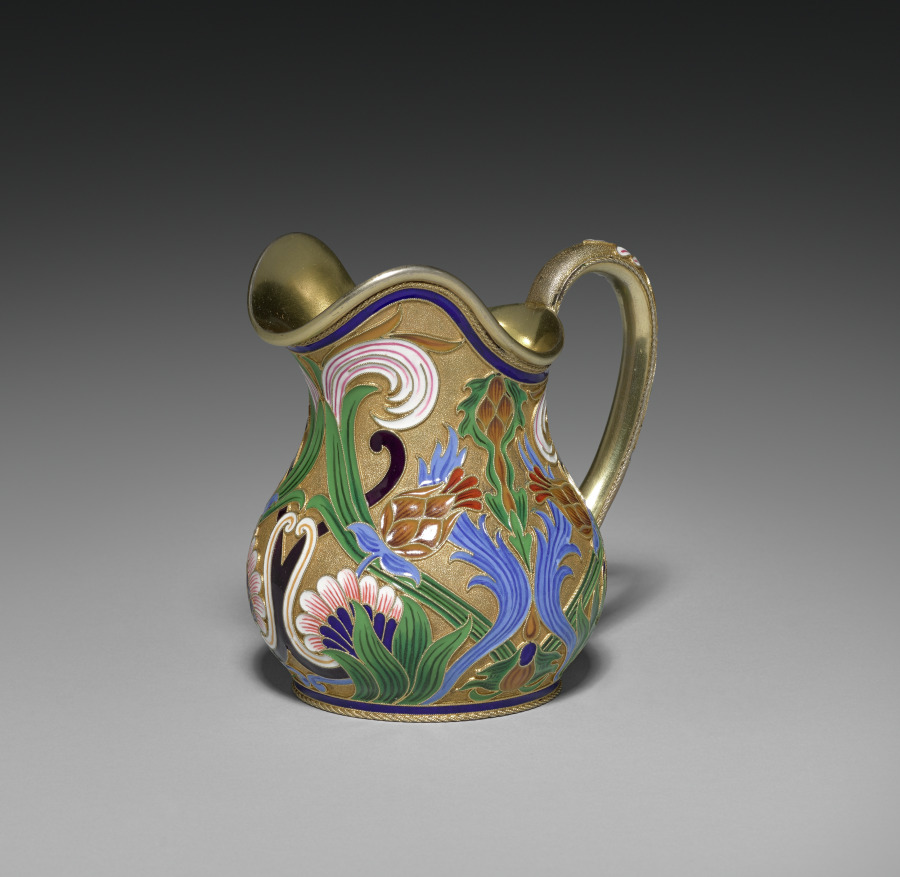
Urban Form: Creamer
I. The Dialectical Frame: From Mortuary Geometry to Urban Structure
The subject—a fractured ceramic mold bearing musicians, paired against a mortuary Taurus figure—offers a rare dual-axis study in volumetric tension. The first artifact compresses kinetic rhythm into a broken plane; the second abstracts biological mass into celestial symmetry. For Addison Fashion’s 2026 executive silhouette, this binary becomes a blueprint for architectural drapery that oscillates between arrested motion and monumental stillness. The creamer, as a domestic object, is here recontextualized not as a vessel for liquid, but as a carrier of spatial memory—its rounded flanks and rigid spout echoing the Taurus’s humped shoulders and the mold’s fragmented edges.
The executive silhouette must therefore reject the soft, body-conformist tailoring of previous decades. Instead, it adopts an oversized carapace: shoulders that mimic the Taurus’s lowered humerus, sleeves cut with the angularity of a broken mold’s cross-section. The garment does not follow the wearer; it houses them, creating a negative space that references the tomb’s interior—a void where breath and movement become deliberate, ceremonial acts.
II. Geometric Integrity: The Ox’s Torso as a Modular Block
A. Horizontal Compression and Vertical Release
The Taurus figure’s defining trait is its cylindrical mass—a body reduced to a smooth, unbroken ellipse. Translating this to tailoring requires a coat or jacket with a single-seam back panel, cut from shoulder to hem without darting. The fabric (a dense, matte wool-silk blend) is forced to fold under its own weight, creating a low, gravitational drape that echoes the ox’s bowed head. The front closure, however, breaks this horizontality with a diagonal placket, referencing the mold fragment’s fracture line. This diagonal is not decorative; it functions as a structural release, allowing the garment to open like a sarcophagus lid—revealing a stark, ivory-toned inner lining that mimics the unglazed ceramic interior.
B. The Spout as a Sleeve Architecture
The creamer’s spout—a sharp, protruding lip—informs the sleeve head. In the 2026 executive silhouette, this translates to a sculpted, forward-pitched shoulder that extends 4–5 cm beyond the natural acromion. The sleeve is cut in two pieces: a front panel that sweeps downward like the spout’s curve, and a back panel that remains flat, echoing the mold’s rough reverse side. This asymmetry creates a kinetic imbalance—the garment appears to be mid-turn, as if the wearer is perpetually pivoting toward an unseen audience. The cuff is left unlined and raw-edged, a deliberate nod to the mold’s broken rim.
III. Structural Poetics: Silence as a Load-Bearing Element
The mortuary Taurus is not merely a symbol; it is a load-bearing metaphor. Its stillness supports the weight of cosmic time. In garment construction, this translates to internal architecture that prioritizes compression over comfort. The 2026 executive coat features a hidden corset-like chassis—boned with rigid, matte-black polymer strips—that forces the torso into a fixed, upright posture. This is not restrictive in a punitive sense; rather, it is ceremonial. The wearer’s spine aligns with the Taurus’s vertical axis, creating a silhouette that reads as both ancient and futuristic.
The mold fragment’s musicians, by contrast, offer a counterpoint of micro-movement. Their gestures are frozen, but their placement suggests a circular rhythm. This is translated into the garment’s pocket architecture: hidden, angled pockets that sit at the hip, slightly rotated toward the front. They are not utilitarian; they are acoustic chambers, designed to hold the hands in a specific, contemplative pose—thumbs outward, fingers curled—mimicking a flutist’s grip. The pockets are lined with a brushed, suede-like microfiber that produces a faint, percussive sound when the hand enters, a subtle auditory reminder of the musicians’ lost melody.
IV. Urban Materiality: Ivory as a Non-Color
The chosen palette—Ivory—is not a soft, creamy white. It is the color of unfired clay, of bone exposed to desert air, of the Taurus’s limestone patina. In urban contexts, this shade functions as a negative color, absorbing the surrounding concrete and glass rather than reflecting it. The fabric is treated with a micro-wax finish, creating a surface that repels water and stains while developing a subtle, irregular sheen over time—a deliberate parallel to the mold’s aged, cracked glaze.
For the 2026 executive, this ivory is paired with hardware in oxidized silver, not polished but brushed to a matte, almost graphite tone. Buttons are replaced by toggle-and-loop closures, inspired by the Taurus’s zodiacal band—each toggle is a small, cylindrical piece of turned bone, echoing the ox’s horns. The overall effect is a garment that reads as archaeological yet performs as armor for the modern metropolis.
V. The Final Silhouette: A Walking Tomb, A Breathing Instrument
The 2026 Addison executive silhouette is not a suit. It is a portable architectural fragment—a piece of the Taurus’s tomb and the mold’s music hall, fused into a single, oversized form. The coat falls to mid-calf, its hem cut on a slight bias to mimic the mold’s irregular edge. Trousers are wide, with a single pleat at the front, but taper sharply at the ankle, echoing the creamer’s narrow base. The overall mass is substantial, but the internal chassis ensures the wearer moves with a controlled, weighty grace—not the brisk stride of commerce, but the deliberate pace of a processional.
This silhouette demands a specific posture: shoulders back, chin level, hands resting in those angled pockets. It is not designed for speed or flexibility. It is designed for presence. The wearer becomes a living ox—not plowing, but standing guard over the urban zodiac. The broken mold’s musicians are not absent; they are internalized, their rhythm now a pulse in the garment’s hidden seams. The Taurus’s stillness is not death; it is the ultimate form of held breath—a pause before the next cosmic rotation.
In this way, the creamer—that humble, domestic object—is elevated to a structural prototype. Its spout, its body, its handle (reimagined as a loop at the back of the coat’s collar) all contribute to a silhouette that is simultaneously ancient, industrial, and futuristic. The 2026 executive does not wear this garment; they inhabit it, as a musician inhabits a mold, as a soul inhabits a zodiac sign. The result is a definitive urban research: geometry as memory, materiality as ritual, and silence as the loudest statement of power.