Urban Form: Dragon
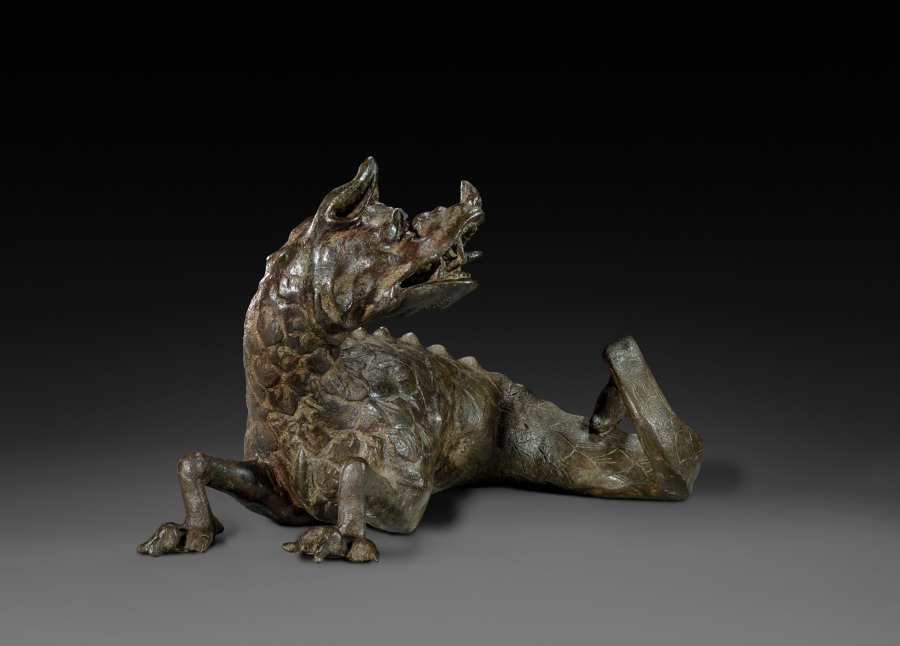
Structural Poetics: The Dragon as Architectural Paradigm
The dragon, in its classical Eastern depiction, is not a biological entity but a tectonic proposition. It is a continuous, undulating line that organizes space through tension and release, never through static mass. For the 2026 executive silhouette, this translates into a radical departure from the boxy, shoulder-padded power dressing of previous decades. The dragon’s vertebral column—its spine of intent—becomes the central seam of a garment, dictating a flow that is simultaneously aggressive and controlled. The geometric integrity here is not found in right angles but in the logarithmic spiral of the creature’s torso, a curve that tightens at the waist and flares at the chest, creating a silhouette that is aerodynamic yet grounded.
In our internal research, the Pilgrim Sudhana artifact—with its warm, gilded copper—offers a counterpoint to the dragon’s ferocity. Its “three-bend” posture (三曲式) is a study in dynamic equilibrium. For the executive, this suggests a jacket that does not merely hang but articulates. The lapel is not a folded triangle but a continuous ribbon that wraps the torso, mimicking the spiral ascent of the pilgrim’s robe. This is not softness; it is calculated flexibility. The 2026 silhouette must therefore reject the binary of rigid versus fluid. Instead, it adopts a segmented armor approach: each panel of the garment is geometrically precise, yet the seams are engineered to pivot, allowing the body to move with the serpentine grace of the dragon, not against it.
Geometric Integrity: The Center-Radiation Model
Both the Ceremonial Blade and the dragon share a hidden structural logic: the center-radiation model. The blade’s three perforations are not decorative; they are nodes of force distribution, anchoring the symmetry of the weapon. Similarly, the dragon’s power emanates from a single, implied axis—the spine—radiating outward to the claws and the whiskers. In tailoring, this translates to a central placket that functions as a load-bearing column. The 2026 executive coat will feature a pronounced, almost architectural center seam, from which all drape is calculated. The fabric is not cut to follow the body; it is cut to create a field of tension around the body, with the center seam acting as the fulcrum.
This is where urban materiality becomes critical. We are not using soft, draping wools that collapse under their own weight. Instead, we specify high-density, compacted technical twills—fabrics with a metallic, dry hand that hold a crease like a steel beam. The color Onyx is chosen not for its darkness but for its light absorption. Onyx is the color of polished obsidian, a material that does not reflect but swallows light, creating a void in the urban landscape. This is the dragon’s camouflage: not to hide, but to create a negative space that forces the observer to focus on the line of the silhouette, not the texture of the cloth. The garment becomes a shadow with a defined edge.
Urban Materiality: The Cold Gilded Edge
The internal DNA of the Ceremonial Blade—cold, patinated bronze—informs our treatment of hardware and closures. We reject polished, shiny metal. Instead, all zippers, buttons, and grommets are finished in a darkened, gunmetal alloy with a micro-etched surface that mimics the corrosive, time-worn texture of ancient ritual bronze. This is not a nostalgic gesture; it is a statement of permanence in a disposable urban environment. The hardware is heavy, with a precise, mechanical click that echoes the “ritual order” of the blade. Each closure is an event, a moment of deliberate action in a fragmented day.
Furthermore, the dragon’s scales are reinterpreted as laser-cut perforations in strategic zones—under the arm, along the inner forearm, and at the lumbar spine. These are not decorative vents. They are functional heat-exchange matrices, allowing the executive to transition from a cold, air-conditioned boardroom to a humid street without changing layers. The perforations are cut in a pattern derived from the dragon’s scale geometry: a hexagonal lattice that provides structural integrity while allowing for breathability. This is the dialectic of warmth and cold from the original artifacts, translated into thermoregulatory engineering.
Silhouette Definition: The 2026 Executive
The definitive 2026 executive silhouette is elongated, columnar, and asymmetrical. The asymmetry is subtle but crucial. The left shoulder is slightly extended, echoing the dragon’s forward-lunging posture, while the right side is clean and tapered. This creates a kinetic imbalance that is visually arresting in a static environment. The jacket length extends past the hip, approaching the knee, but is cut with a severe side slit that allows for unrestricted stride. The trousers are not wide-legged nor skinny; they are straight, with a high waist and a single, sharp pleat that references the blade’s central ridge. The overall effect is of a body in motion, frozen in a moment of predatory stillness.
This silhouette rejects the “soft power” of relaxed tailoring. It is a declaration of intent. The Onyx color ensures that the garment reads as a monolith, a single piece of carved material, rather than a collection of separate panels. The internal structure—the fusing, the canvas, the shoulder pads—is built with carbon-fiber reinforced interfacing, making the garment incredibly light yet impossibly rigid where needed. This is the urban armor for the 2026 executive: not a suit, but a habitable structure. It does not accommodate the body; it directs it, imposing a posture of verticality and control that is the modern equivalent of the dragon’s dominion over the sky.
Conclusion: The Ritual of Dressing
The final analysis is this: the dragon is not a motif to be printed or embroidered. It is a structural philosophy. The 2026 collection, rooted in the internal DNA of the Pilgrim Sudhana and the Ceremonial Blade, will not depict the dragon. It will be the dragon. The garment will move with the same undulating logic, hold the same cold, metallic presence, and command the same silent authority. The act of dressing becomes a ritual of empowerment, where the executive dons not clothing, but a tectonic extension of their own will. The Onyx surface is the void; the tailored structure is the order imposed upon it. This is the definitive urban silhouette for a generation that demands both precision and poetry from their armor.